The Agile Plateau: Why Your Transformation Stalled and What Evidence-Based Management Does About It
Two years into the Agile transformation, the events are still running. The teams have been trained. The Scrum Masters are in place. Refinement happens on Tuesdays. The Daily Scrum starts at 09:30 and finishes by 09:45. There is a programme increment plan on the wall, and a roadmap on Confluence that everyone references but few read.
And yet (when the CEO asks what has actually changed for the business) the answer is awkward.
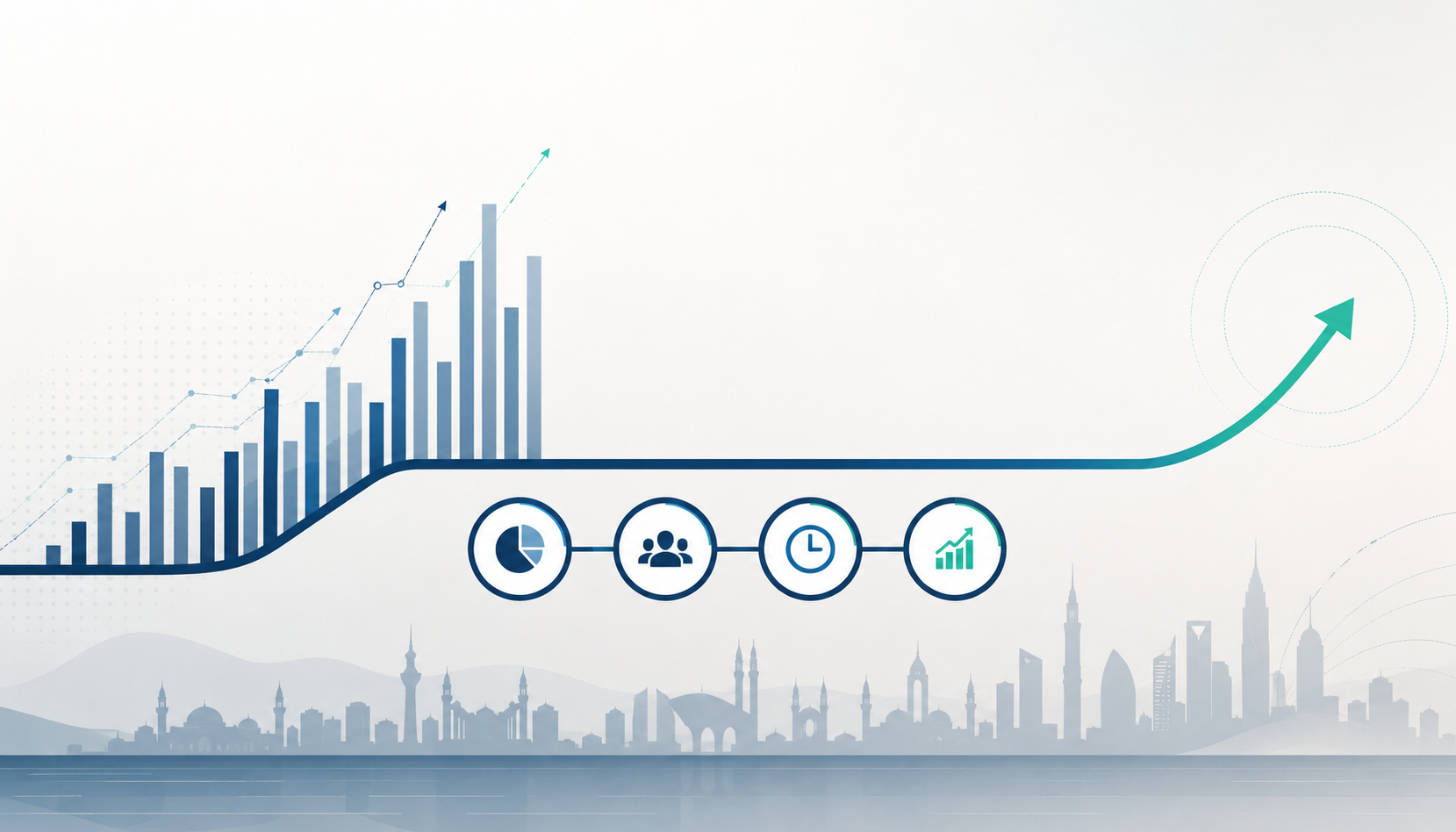
This is the Agile Plateau. It is not where transformations fail. The teams are doing what they were taught. The cadence is real. The tooling works. But the line that should have moved (time to market, customer outcomes, the ability to respond to a regulator or a competitor) has not moved enough to defend the investment.
Nearly every transformation leader I speak to across the UAE and the wider GCC has stood on this plateau. Most are reluctant to name it.
How the Agile transformation plateau forms
The plateau forms because most transformations are measured by activity, not by value.
We count the teams trained. We count the events run. We count the certified Scrum Masters. We measure adoption of the framework. We do not measure whether anything got better for the customer or the business, because that measurement is harder, and because the framework itself does not require it.
This is the difference between Agile adoption and genuine Agile transformation. Adoption is the visible cadence. Transformation is the change in outcome. They look the same for the first eighteen months, and then they don't.
It is also the difference between Scrum used and mechanical Scrum performed, a pattern where the meetings happen but the empiricism that gives them their value has been left at the door.
This is not a criticism of Scrum, or Kanban, or Scaled Agile. They were never designed to be the destination. They are mechanisms, useful, often necessary, never sufficient. The destination is value delivered to customers and outcomes delivered to the business.
When the mechanism becomes the metric, the plateau is the predictable result.
Why the plateau is especially pronounced in the GCC
The pattern is not unique to this region, but it is pronounced here. Three reasons.
First, transformation programmes in the GCC are often launched at the pace of national strategy (Vision 2030, We the UAE 2031, Qatar National Vision 2030) which means the brief lands at the executive committee with a deadline and a budget before the operating model has been thought through. Activity is easier to demonstrate than outcome when the clock is already running.
Second, the regional preference for visible structure (programme increments, certified roles, dashboards) rewards the appearance of transformation. Boards and ministries see what is countable. They do not always see what is changing.
Third, the consultancy supply chain that supports these programmes has historically been paid for delivery of frameworks, not delivery of outcomes. The economics of the engagement reinforce the wrong end of the value chain.
I have written elsewhere about why Agile transformations fail in the Middle East and how to fix the underlying causes. The Agile Plateau is what failure looks like when nothing has gone visibly wrong.
Evidence-Based Management: the lens that breaks the plateau
Evidence-Based Management (EBM), from Scrum.org, exists for exactly this problem. It does one thing well: it forces you to measure value, not activity, and to make investment decisions based on what the evidence shows.
EBM organises measurement around four Key Value Areas. They are not radical. They are not new. They are simply the questions most transformation reports do not ask.
Current Value (CV). What is the product or service delivering to its users and the business today? Not what it could deliver. Not what it will deliver next quarter. Today. For a retail bank, this includes Net Promoter Score, customer satisfaction with the mobile app, employee engagement in the digital channels team, and revenue per customer. For a telecoms operator, it includes ARPU, customer churn, and time-to-resolution on service tickets.
Unrealised Value (UV). What value could be delivered if the product or service met every reasonable customer need, and how large is the gap between that and Current Value? UV is the case for change. Without it, you cannot defend further investment. A bank that has digitised 60% of customer journeys has a known UV gap in the remaining 40%. A government service operator that has reduced wait times to ten minutes has a UV gap to the customer who would prefer no wait at all.
Time-to-Market (T2M). How quickly can the organisation deliver new capability into the hands of customers? Release frequency, lead time, cycle time, the time between idea and live. This is where the Agile transformation should have moved the line, and where, on the plateau, it stubbornly hasn't.
Ability to Innovate (A2I). How effectively can the organisation deliver new capability that customers actually want? Defect density, technical debt, the proportion of engineering capacity spent on innovation versus maintenance, the proportion of features used after release.
Most transformation programmes have rich data on activity and almost none on these four. Choosing the right Agile metrics to track (and stopping the metrics that distort behaviour, like raw velocity targets) is the single highest-leverage move available to a transformation leader on the plateau.
What changes when you measure value
Once you measure CV and UV, the board conversation changes. The question stops being "how many teams are now trained" and becomes "how is the gap between current and unrealised value closing." That question is hard to answer with a status report and much easier to answer with evidence.
Once you measure T2M and A2I, your delivery decisions sharpen. You stop optimising local cadence and start asking why a feature still takes 14 weeks from idea to production. You stop celebrating velocity and start asking whether the things being delivered are the things customers asked for.
We saw this play out at MTN GSSC, where applying these principles to procurement reduced strategic RFP cycle times by 55% and brought more than 80% of the organisation into the new way of working. The lever was not new tooling or a new framework. It was making cycle time visible, treating it as the metric that mattered, and running short experiments against it. The full MTN GSSC Lean-Agile Procurement case study is worth reading for the operating mechanics; the principle behind the result is simply T2M elevated from a delivery curiosity to an executive metric.
How to step off the Agile plateau
Stepping off the plateau does not require restarting the transformation. It requires three changes that most organisations can make in a quarter.
One. Pick two metrics in each Key Value Area. Not twelve. Two. Make them visible to the executive team. Update them monthly. Resist the temptation to track everything; the discipline is in choosing.
For a typical UAE retail bank, the eight metrics might be: NPS and digital adoption rate (CV); unmet need analysis and feature backlog value-weighted (UV); idea-to-production lead time and release frequency (T2M); defect escape rate and percentage of capacity on innovation (A2I).
Two. Stop reporting activity to the board. Replace "85% of teams now using Jira" with "T2M reduced from 14 to 9 weeks across the priority value stream." If you cannot yet make that swap, that is the first piece of work. The activity report is a comfortable artefact; it is also the artefact that built the plateau.
Three. Run experiments against the gap. Not multi-quarter programmes. Short, hypothesis-led experiments, change one thing, measure the effect, decide based on the evidence. EBM is a measurement framework but it is also a decision-making discipline, and the second part is where most organisations stall.
For organisations that want a structured starting point rather than a free climb, an Agile Maturity Assessment combining EBM with AgilityInsights® gives you a calibrated baseline in two to four weeks. The point is not the assessment itself; the point is to get a defensible measurement of where the plateau is, before you try to step off it.
Three questions to take to your next executive review
If you are unsure whether your transformation is on the plateau, these three questions usually settle it within a meeting.
- What was our Time-to-Market on the last three priority initiatives, measured from concept-approved to in-production? If the answer requires research, you are on the plateau. If the answer is a number that has not improved in eighteen months, you are firmly on it.
- What does the gap between Current Value and Unrealised Value look like in our most important customer journey? If the team cannot describe Unrealised Value at all, the transformation has been measuring activity. If they can describe it but cannot point to evidence of it closing, the cadence is producing motion without progress.
- In the last quarter, what experiment did we run, and what did the evidence tell us? Not a project. Not a release. A genuine experiment with a hypothesis and a measurable outcome. Most plateaued organisations have not run one.
The discomfort of these three questions is the diagnostic. Welcome it. The discomfort is also the only thing that breaks the plateau.
The plateau is the moment that matters
The Agile Plateau is not where transformations fail. It is where transformations decide what they actually are. The organisations that stay on the plateau treat Agile as something they have done. The organisations that step off treat Agile as something they use, deliberately, to deliver evidence of value.
If you recognise the plateau in your own programme, the question is not whether to start again. It is whether you are willing to measure what matters now.
Take the next step
If you would like a structured view of where your transformation stands across the four Key Value Areas, the Agile Readiness Assessment is a free 15-minute diagnostic. It is the fastest way to find out whether your transformation is on the plateau, and which of the four KVAs is most likely to move first if you step off.
For deeper engagement, coaching, advisory, a full Maturity Assessment, or transformation support across the UAE and GCC, please contact the Agility Arabia team. We respond within one working day.